
Introduction

I still remember the first time I asked my phone to summarize a long article while I was on the LRT. AI felt like magic, but behind the magic are practical skills you and I can learn. If you’re curious about AI and want a structured, job-ready path in Malaysia, this guide is my honest rundown of the essentials you need to know before committing to a Diploma in Artificial Intelligence. I’ll keep it mobile-first (because most of us learn on our phones), clear about privacy (because PDPA matters), and tuned to what’s happening right now in 2025. By the end, you’ll know if a diploma in ai fits your goals, budget, and lifestyle.
What is the Diploma in Artificial Intelligence?
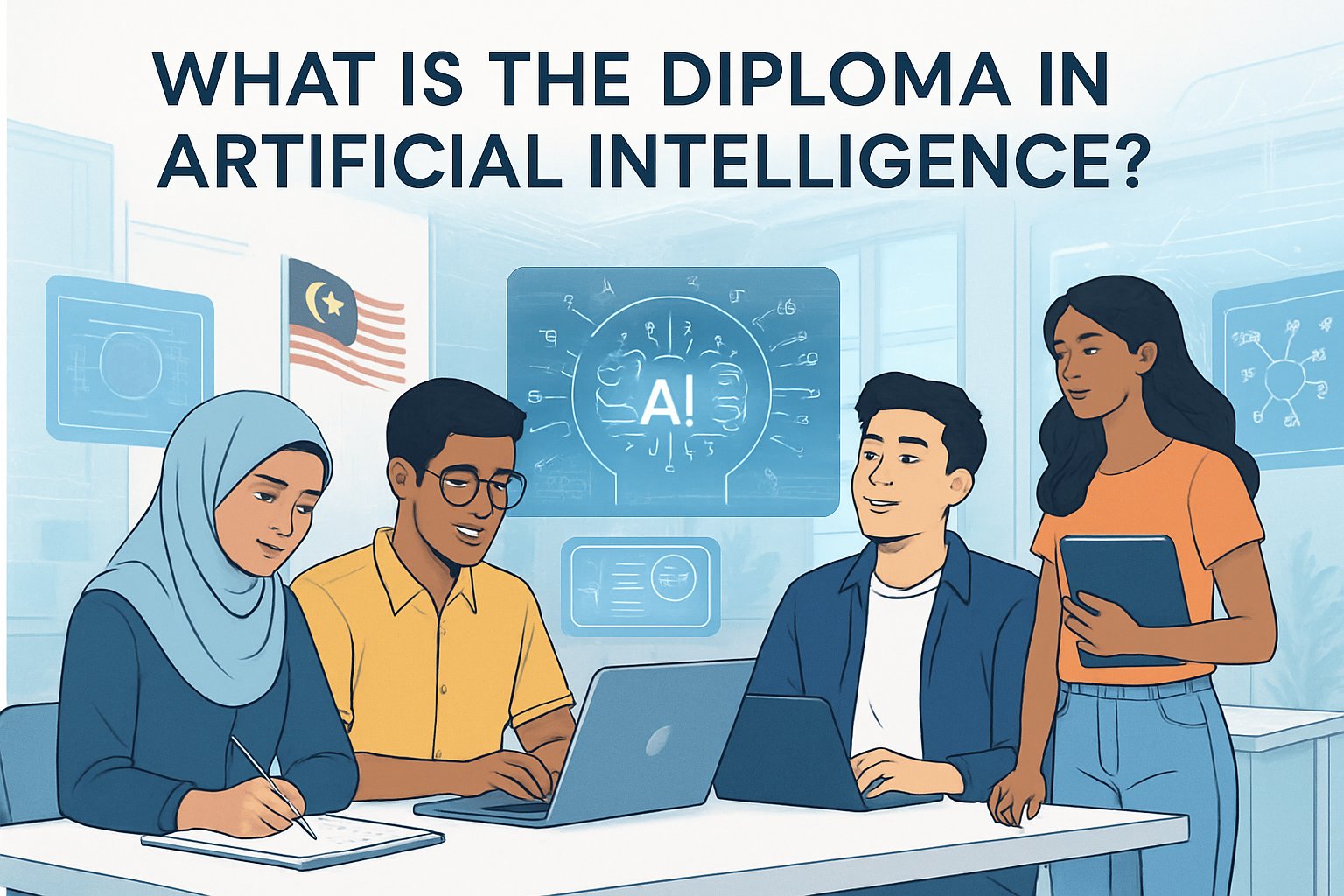
Embarking on a diploma in artificial intelligence in Malaysia provides a solid foundation for anyone interested in the rapidly evolving field of AI. This qualification bridges the gap between basic education and advanced studies, offering practical skills that are immediately applicable in the job market. Whether you’re a fresh graduate or switching careers, understanding what this diploma entails can help you make an informed decision.
A Diploma in Artificial Intelligence is a foundational qualification that teaches you how machines learn from data and make predictions. It sits between SPM/STPM level learning and a full degree, and it’s designed to get you hands-on quickly with the tools that power everyday AI—think recommendation engines, chatbots, and computer vision. In Malaysia, diploma programs typically balance theory with practical labs, so you learn not only the concepts but also how to build and ship small AI projects that run on a laptop or even a smartphone.
Compared with a general IT diploma, an AI-focused diploma spends more time on data, algorithms, and model deployment. You’ll still touch programming, databases, and software engineering, but you’ll go deeper into machine learning workflows, ethical AI, and how to keep user data safe. It’s a good choice if you want to enter the workforce quickly in a junior role or build a base for a later degree. Many programs emphasize real-world applications, ensuring graduates are prepared for the demands of Malaysia’s growing tech industry.
What are the main topics covered in the Diploma in Artificial Intelligence?
Diving into the curriculum of a diploma in AI reveals a comprehensive set of topics designed to build your expertise from the ground up. These subjects are carefully selected to align with industry needs, incorporating both technical skills and ethical considerations. As you progress, you’ll find the topics interconnect, providing a holistic understanding of artificial intelligence.
At beginner level, you’ll progress from core computing to AI-specific subjects. Expect to start with programming (often Python), basic math for AI (linear algebra and statistics), and then modules on machine learning, data wrangling, and model evaluation. You’ll likely explore supervised and unsupervised learning, fundamentals of neural networks, natural language processing basics, and computer vision essentials. Many programs also include cloud and edge deployment for mobile-first scenarios, because running AI on-device is increasingly common to preserve privacy and reduce latency.
On the responsible AI side, PDPA compliance, data anonymization, consent, and bias mitigation are key. You should also see modules covering prompt engineering for generative models, MLOps basics for versioning and monitoring models, and teamwork practices like Git workflows. The goal is to make you job-ready with practical exposure, not just theory. This focus ensures that graduates of AI courses in Malaysia are well-versed in both innovation and responsibility.
What will I learn?
A diploma in AI equips you with a blend of theoretical knowledge and practical abilities, setting the stage for a successful career in technology. You’ll gain insights into how AI systems are built and maintained, with an emphasis on real-world implementation. This section breaks down the learning journey, highlighting the structure and outcomes of the program.
Programme structure
Most diplomas follow a staged structure. In the first stage, you’ll get comfortable with programming fundamentals, command-line basics, and simple data tasks. This foundation is crucial for building more complex skills later on.
In the second stage, you’ll dive into core machine learning concepts such as regression, classification, clustering, feature engineering, and model evaluation techniques like cross-validation. These elements form the backbone of AI applications. You’ll practice these through hands-on exercises that simulate real scenarios.
In the third stage, you’ll apply these tools to real use cases such as sentiment analysis or image classification and learn how to deploy lightweight models to the cloud or mobile devices. There’s usually a capstone or industry project, which is where all the pieces come together. You’ll learn to scope the project with privacy in mind, gather consent where needed, and implement security controls, especially if personal data is involved. By the end, you should have a portfolio artifact you can show employers—preferably something that proves you can solve a real Malaysian use case, like optimizing deliveries in KL traffic or classifying Bahasa Melayu text.
Programme outcomes
By completion, you should be able to write clean Python code, build and evaluate ML models, and deploy simple solutions with basic monitoring. You’ll also be able to explain trade-offs to a manager—like why a smaller on-device model might be better for privacy and latency than a centralized, data-hungry system. Additionally, you’ll learn to document data lineage, handle PDPA considerations, and communicate risks around bias, drift, and misuse.
Soft skills matter too. You’ll get used to agile teamwork, version control, code reviews, and presenting results clearly. Employers appreciate grads who can connect the dots between business goals and technical decisions, not just run a Jupyter notebook. This combination of technical and interpersonal skills makes you a versatile professional in the AI field.
Is the Diploma in Artificial Intelligence an online course?
In today’s digital age, flexibility in learning is key, and many diploma in AI programs in Malaysia cater to this by offering online options. These formats allow you to study at your own pace while balancing other commitments. Understanding the online aspects can help you choose the right mode for your lifestyle.
Many Malaysian providers offer fully online or blended options. Online doesn’t mean low quality; it means you’ll need discipline and good time management. For mobile-first learners like me, online modules that stream well on a phone, offer subtitles, and provide downloadable notes are a big plus. Some institutions run hybrid labs, where you attend in-person workshops for hands-on practice with hardware like GPUs or edge devices while keeping lectures online.
If privacy is your priority, look for platforms that comply with PDPA, allow you to control data sharing, and provide clear consent forms. Some providers also permit anonymous forum handles or localized data storage, which is helpful if you’re working with sensitive datasets. This ensures your learning experience is both effective and secure.
How can I enroll in the Diploma in Artificial Intelligence?
Enrolling in an AI diploma in Malaysia is a straightforward process, but knowing the steps can make it smoother. This guide outlines the typical procedure and tips to prepare effectively. Starting early can give you an advantage in securing your spot.
The exact process varies by institution, but the flow is similar. You’ll check entry requirements (often SPM or equivalent, with a pass in Math and English), prepare documents, submit an application online, and wait for an offer. If there’s an interview or a short aptitude test, it’s usually to gauge your motivation and basic numeracy, not to grill you on advanced AI.
To keep it practical, I like to compare two to three providers side by side, focusing on modules, faculty credentials, privacy policies, and student support. If possible, join a trial class or watch sample lectures to test the pacing on your phone. You can also ask admissions about scholarships or fee plans in RM and request clarity on any extra costs, like exam or certification fees. Researching thoroughly ensures the program aligns with your career goals in artificial intelligence.
How long does it take to complete the Diploma in Artificial Intelligence?
The duration of a diploma in AI can vary based on your chosen mode of study, impacting how quickly you can enter the workforce. Understanding these timelines helps in planning your education around life’s demands. Here’s a closer look at the typical structures available in Malaysia.
Diplomas typically take 24–30 months full-time. Part-time and modular pathways can stretch to 36 months, which suits those of us working or juggling family commitments. Some providers offer credit recognition for prior learning, which may shorten the timeline if you already have related modules.
| Mode | Typical Duration | Weekly Time | Best For |
|---|---|---|---|
| Full-time (on-campus/blended) | 24–30 months | 25–35 hours | School leavers aiming to enter workforce quickly |
| Part-time (online/hybrid) | 30–36 months | 10–15 hours | Working adults needing flexibility |
| Modular stack (short courses to diploma) | Varies (stack credits) | 5–10 hours | Learners testing the waters before fully committing |
Remember to budget time for the capstone. It often requires extra weeks for data collection, stakeholder interviews, and feedback cycles—very realistic to how industry projects run. Planning ahead for these intensive periods can make the experience more manageable and rewarding.
Is the course self-paced or instructor-led?
Choosing between self-paced and instructor-led formats for your AI diploma depends on your learning style and schedule. Each has its advantages, from flexibility to structured guidance. Exploring these options can help you select the best fit for success in your studies.
You’ll find both formats available. Instructor-led formats give structure, deadlines, and live feedback. Self-paced formats let you learn whenever you have a window—between shifts, during commutes, or late nights. Many programs blend the two: pre-recorded content plus monthly live clinics or tutoring. The right choice depends on your discipline level and schedule.
What is meant by online self-paced learning?
Self-paced means you control your study rhythm within an overall deadline. You watch short videos, read notes, and attempt quizzes when you’re ready. Good self-paced courses still carry guardrails: milestone dates, practice projects, and optional live sessions so you don’t feel isolated.
On mobile, prefer platforms with adjustable playback speed, offline downloads, and transcripts for quick revision. Privacy-wise, self-paced systems should clearly state what they track—progress, quiz attempts, and device info—and provide settings to opt out of marketing use. If a course uses third-party AI tools, check whether your prompts or uploads are stored or used for model training. This transparency is essential for maintaining trust in online AI education in Malaysia.
How do I learn with UniAthena?
Learning with UniAthena offers a modern approach to acquiring AI skills, tailored for busy learners in Malaysia. Their platform emphasizes accessibility and practical application. This section explores how their methods can support your educational journey.
UniAthena typically delivers content online through a learning platform with bite-sized lessons, readings, and quizzes. You can revise on mobile, participate in forums, and submit assignments digitally. Their approach often emphasizes micro-learning and continuous assessment, which helps if you’re balancing work and study.
While branding is neutral here, always review the latest syllabus, PDPA-related statements, and any optional fees before enrolling to ensure the setup matches your privacy comfort level. If you’re a beginner, start with orientation modules and sample exercises to build confidence. The key is to be consistent—15 to 30 minutes daily goes a long way. This routine can significantly enhance your mastery of artificial intelligence concepts.
What skills will I gain from this course?
Completing a diploma in AI arms you with a toolkit of essential skills that are highly valued in the job market. These range from technical proficiencies to soft skills that enhance collaboration. Gaining these abilities positions you well for various roles in Malaysia’s tech sector.
Technically, you’ll learn Python programming, data handling with libraries like pandas, model training using scikit-learn or similar frameworks, and basic neural networks. You’ll pick up MLOps fundamentals: version control, experiment tracking, and lightweight deployment. On the mobile-first side, you might convert models to run on-device, which reduces data sharing and boosts speed—great for privacy and real-time use cases.
Professionally, you’ll practice communicating results, writing documentation, and working in teams. Ethically, you’ll learn to assess datasets for bias, collect consent properly, and apply PDPA-informed design principles. These are the skills that make a junior AI practitioner useful from day one. Moreover, they provide a strong foundation for further advancement in AI careers.
How will this diploma benefit my career?
A diploma in AI can be a game-changer for your professional path, opening doors to exciting opportunities in Malaysia. It provides not just knowledge but also credentials that employers recognize. Let’s examine how this qualification can accelerate your career growth.
This diploma opens doors to roles like AI assistant, data analyst trainee, ML ops support, or junior NLP/CV technician. Employers in fintech, e-commerce, logistics, healthcare, and manufacturing all need people who understand data workflows. In Malaysia’s current landscape, many companies prefer hands-on problem solvers over pure theorists, so a strong project portfolio can stand out even at the diploma level.
Beyond the first job, your diploma can stack into advanced certificates or a degree. If you keep a portfolio and nurture privacy-first practices, you’ll be trusted with sensitive projects sooner. Over time, that trust is career capital—you’ll get better projects and faster progression. Ultimately, it positions you as a valuable asset in the burgeoning field of artificial intelligence in Malaysia.
How does the assessment for the courses work?
Assessments in an AI diploma program are designed to evaluate your understanding and application of concepts comprehensively. They combine various methods to ensure a well-rounded evaluation. Knowing the structure can help you prepare effectively for success.
Assessments usually combine quizzes, assignments, and a final project. Quizzes check concept understanding; assignments test your ability to apply tools; the capstone showcases end-to-end problem solving. Some modules use proctored exams or viva-style presentations, especially when verifying your own work for academic integrity and privacy compliance.
In data-centric tasks, you’re expected to handle personal information responsibly. That might include anonymizing names, masking IDs, and storing files securely. Submitting code with clear documentation and version history helps markers understand your approach and safeguards against plagiarism.
What happens if I fail the quiz? Do I have an option to retake the quiz?
Most providers allow at least one retake, sometimes with a cooling-off period. The idea is to encourage learning, not to punish. After a failed attempt, review the feedback, revisit the lesson, and try again.
If retakes are limited, plan your attempt when you’re well-prepared, avoiding late-night rushes on mobile data—been there, not fun. If you repeatedly struggle, reach out to support or instructors early. They can clarify tricky topics and may point you to remedial materials or live sessions. This support system is crucial for overcoming challenges in your AI learning journey.
How is my progress tracked during the course?
Tracking progress in an online AI diploma helps you stay on course and identify areas for improvement. Platforms use sophisticated tools to monitor your advancement. This feature is particularly useful for self-motivated learners in Malaysia.
The learning platform typically records completed lessons, quiz scores, and assignment submissions. You can view progress dashboards and receive nudges if you’re falling behind. For privacy, check how long the platform retains your activity data and whether it’s shared with third parties.
A transparent policy should explain what’s collected and why, aligned with PDPA standards. This ensures your data is handled responsibly throughout the course. Regularly reviewing your progress can also motivate you to maintain momentum in your studies.
Can I enroll in more than one program simultaneously?
Balancing multiple programs while pursuing a diploma in AI requires careful consideration of your time and energy. It’s possible, but strategic planning is essential. This approach can broaden your knowledge but demands discipline.
Yes, but be realistic. Two programs at once can be intense, especially if both have projects. Prioritize one as your main track and treat the other as enrichment.
If time is tight, use the self-paced nature of one to avoid burnout. Remember, consistent effort beats overload—quality learning over quantity. This mindset helps in achieving better outcomes without compromising your well-being.
Are these courses really free?
Many AI diploma programs advertise free elements, but understanding the full cost structure is vital. This can affect your budgeting and expectations. Let’s clarify what ‘free’ typically entails in these contexts.
Some providers offer free-to-learn content with optional paid services. It’s common to see no tuition for the learning materials, but fees for exams, grading, or certificates. Always clarify the total cost in RM before committing—ask about exam retake fees, proctoring, printing, or verification charges. “Free” usually means access, not certification.
Are these courses accredited?
Accreditation varies. In Malaysia, you can look for programs aligned with MQA guidelines or offered by recognized institutions. If a course is non-accredited but industry-aligned, it can still be valuable for skills-building and portfolios.
The approach is to balance accreditation with the quality of modules, projects, and instructor support—then choose what best fits your goals and budget. This ensures you’re investing in a program that holds value. Ultimately, accreditation can enhance the credibility of your diploma in AI.
What are short courses?
Short courses serve as accessible entry points into AI, offering focused learning without long-term commitment. They are ideal for testing interests or building specific skills. In Malaysia, these can complement a full diploma program.
Short courses are bite-sized modules—like “Intro to Machine Learning” or “Prompt Engineering”—that you can complete in days or weeks. They work well as a test drive before committing to a diploma. Some providers let you stack these micro-credentials into diploma credits, which spreads costs over time and reduces risk.
If you’re new to AI, a short starter course can build momentum fast. These courses often focus on practical applications relevant to local industries. They provide quick wins that boost confidence and knowledge.
When can I claim the certificate?
Claiming your certificate marks the culmination of your AI diploma efforts, providing tangible proof of your achievements. Timing and procedures vary, so planning ahead is beneficial. This section details the process and related considerations.
Typically, you can claim a certificate once you complete all required assessments and meet the passing criteria. Processing can take a few working days, especially if there’s verification involved. If you’re in a hurry—for job applications or visa documentation—notify support early and keep your records (ID, student number) handy.
Are the certificates verified?
Many providers issue digital certificates with verification links or QR codes. Employers can check authenticity online, which speeds up hiring processes. Verified credentials also reduce the risk of fraud, supporting a trustworthy talent pipeline in Malaysia’s AI ecosystem.
This verification adds value to your qualification. It assures employers of your skills’ legitimacy. In a competitive job market, this can give you an edge.
Is there any validity period after course completion to claim the certificate?
Policies differ. Some let you claim anytime after completion; others set a window and may charge a late fee. Always read the fine print and set reminders so you don’t miss deadlines.
If there’s a grace period, aim to claim immediately to avoid policy changes later. This proactive approach ensures you secure your certificate promptly. It also helps in maintaining momentum post-completion.
How do I claim the certificate?
The process is usually straightforward through the learner portal. To keep things smooth and privacy-aware, make sure your profile details are correct and only the necessary information is shared. Once issued, store a secure digital copy in cloud storage and keep an offline backup, just in case.
Complete all modules and pass required assessments as the first step. Then, confirm your details and consent settings in the portal. Finally, submit the certificate request and pay any applicable RM fees. This structured process ensures a hassle-free experience.
Can I access the course materials after completion?
Access to materials post-completion allows for ongoing reference and skill reinforcement in your AI career. Policies vary, so selecting a provider with favorable terms is wise. This can be a key factor in long-term learning value.
Often yes, but access terms vary. Some platforms keep your materials available for revision; others limit access to a defined period. If you plan to revisit content for interviews or project refreshers, choose a provider with generous post-completion access or let you download notes for personal use.
When downloading, double-check that any dataset with personal information is properly anonymized and stored securely. Your device lock, encrypted storage, and careful sharing habits protect you and any data subjects. This practice upholds the privacy principles learned in the course.
How long do I have access to the course resources?
Knowing the duration of access to course resources helps in planning your study and review strategy for an AI diploma. It ensures you can revisit materials as needed. Providers in Malaysia offer varying terms to suit different needs.
Access can range from lifetime to a few months after completion. If lifetime access is offered, it may apply to the current version of materials; major updates might be separate. Keep an eye on emails or portal notices about changes in content availability, and schedule refreshers on your mobile calendar to stay sharp.
Even if access ends, the skills and projects you built are yours. Maintain your Git repo, export your notebooks, and keep a tidy portfolio. That way, your learning remains portable across platforms and job applications. This portability is invaluable for ongoing career development.
FAQs
Addressing common questions about pursuing a diploma in AI in Malaysia can clarify uncertainties and aid decision-making. Below are some frequently asked queries with detailed answers. These cover practical aspects from prerequisites to career impacts.
Do I need a strong math background to start a Diploma in AI?
You don’t need advanced math to start, but comfort with basic algebra and statistics helps. The diploma will teach you the essentials step by step, and practice exercises will build your confidence. If you feel rusty, take a short prep course first. This approach ensures a smooth entry into the program.
Can I study entirely on my phone?
Yes, many modules are mobile-friendly with short videos, transcripts, and quizzes. For coding, you’ll be more efficient on a laptop, but you can still revise, watch lectures, and take notes on your phone. Look for platforms with offline downloads and low-data modes. This flexibility is ideal for on-the-go learning in Malaysia.
How much should I budget for fees in RM?
Fees vary by provider and format. Some offer low-cost or free learning materials, with additional fees for assessments and certificates. Always request a full fee breakdown in RM, including potential exam retakes and verification charges. Budgeting accurately helps avoid surprises during your studies.
What portfolio pieces impress Malaysian employers?
Projects that solve real local problems—like Bahasa Melayu sentiment analysis, demand forecasting for SMEs, or on-device vision models—stand out. Clear documentation, ethical data handling, and measurable outcomes make a strong impression. Host your code and include a concise README. Such portfolios demonstrate practical skills valued in the industry.
Is data privacy really that important for junior roles?
Absolutely. Even juniors handle data pipelines and model outputs. Demonstrating PDPA awareness, consent handling, and anonymization shows maturity and earns trust. That trust often leads to better projects and faster progression. Prioritizing privacy sets a strong foundation for your AI career.
About The Author
